Different Types of Embedded Insurance
If you’ve been hearing the term embedded insurance more often lately, you’re not imagining things. It’s rapidly reshaping distribution channels across the modern insurance market. Major retailers, fintech platforms, and OEMs are bundling coverage directly into the e-commerce checkout experience, often reducing insurance to a one-click decision.
But here’s the reality most tech-focused articles miss: this isn’t just a product shift: it’s a distribution shift. And while embedded models win on speed and a frictionless purchase, they also introduce coverage blind spots that reinforce the value of the independent insurance agent.
In this article, we talk about the types of embedded insurance, how each mechanism actually works, and most importantly, how you can compete without sacrificing your book of business, advisory role, or carrier flexibility.
- Embedded insurance is a distribution channel, not a product. It is delivered at the point of sale (POS) via API integration.
- There are four core mechanisms: intrinsic, opt-out bundled, opt-in bundled, and billboard. These mechanisms determine how coverage is presented and purchased.
- The less effort required from the user, the higher the conversion rates, but the lower the customization.
- Embedded insurance works well for low-risk, transactional coverage, but creates significant coverage gaps for complex risks.
- Independent agents can compete by leveraging digital marketplaces and quote and bind platforms to match speed without sacrificing advisory value.
Independent Agents!
Accelerate Your Agency’s Success
 Top Commissions
 No Fees
 Instant Access
What Does Embedded Mean in Insurance?
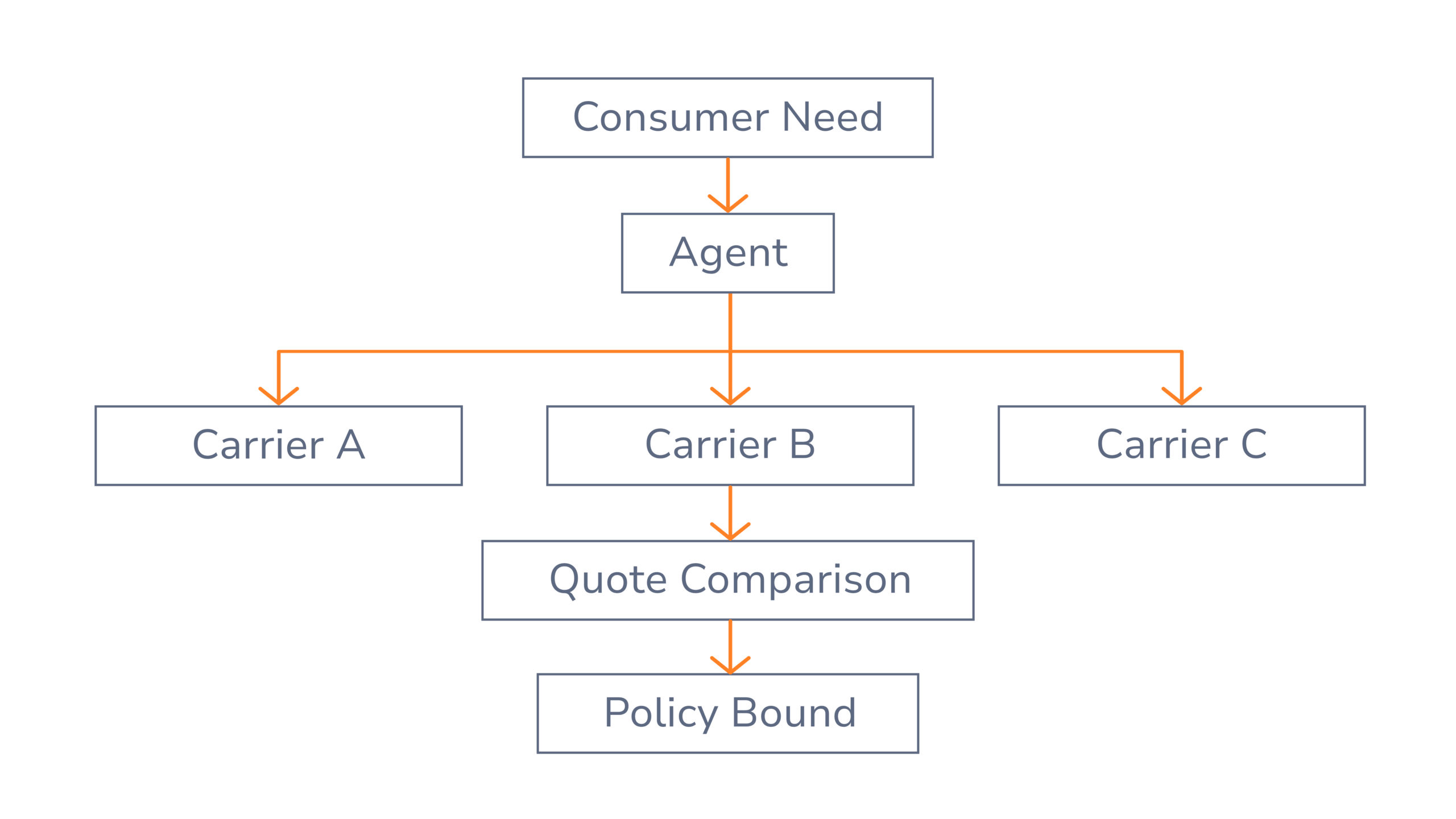
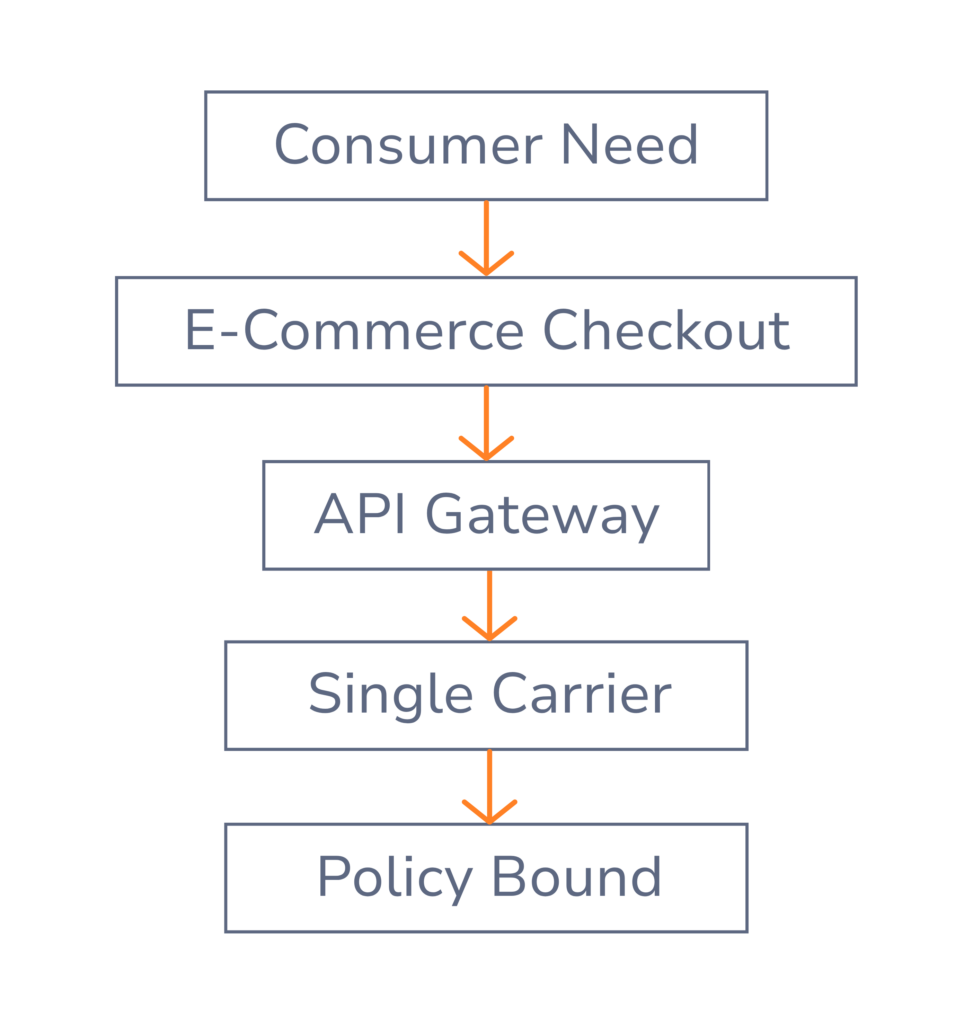
Embedded insurance refers to the real-time integration of coverage into the purchase of a non-insurance product or service, typically delivered at the point of sale (POS) through API integration. Unlike the traditional agency model, where agents compare multiple carriers through a quote and bind workflow, embedded insurance offers a pre-selected policy instantly within the same transaction, creating a frictionless purchase but limiting customization and carrier choice.
FLOW 1: TRADITIONAL AGENCY MODEL
FLOW 2: EMBEDDED INSURANCE MODEL
The 4 Core Types of Embedded Insurance Explained

To properly evaluate embedded insurance, it is important to categorize it by integration mechanism, not product type. From an agent’s perspective, this is where things get practical.
A common pattern across the market is that clients assume they have ‘full coverage’ after selecting a checkout option, when in reality the policy is often highly limited. Understanding these mechanisms helps you quickly assess what your client actually bought.
Here are the different types of embedded insurance:
- Intrinsic/Native: Built directly into the product price
- Opt-out bundled: Included by default unless removed
- Opt-in bundled: Requires active user selection
- Billboard/Affinity: Displayed offer requiring a separate quote flow
| Integration Type | User Action Required | Friction Level | Conversion Potential | Real-World Example |
| Intrinsic/Native | None | None (Invisible) | Very High | Airbnb host protection built into platform |
| Opt-Out Bundled | Must uncheck box | Very Low | High | Pre-selected travel insurance at checkout |
| Opt-In Bundled | Must select checkbox | Moderate | Medium | Add-on phone protection during purchase |
| Billboard/Affinity | Click + separate quote | High | Low | Insurance link on booking site redirecting elsewhere |
-
Intrinsic Embedded Insurance
Intrinsic (or native) embedded insurance is completely invisible to the buyer. The coverage is baked into the product itself and cannot be removed.
From a B2B2C distribution standpoint, this is the most seamless model. The consumer doesn’t make a decision, the protection is simply part of the value proposition.
- Friction level: None
- Conversion rate: Near 100%
- Customization: Zero
Examples include protections built into platforms like short-term rental host coverage or device guarantees bundled into pricing.
This creates a seamless digital experience, but from an underwriting perspective, it’s highly standardized and rarely tailored to individual risk profiles.
-
Opt-Out Bundled Insurance
With opt-out bundled models, coverage is pre-selected in the cart and included unless the user actively removes it.
This model is powerful for improving conversion funnel performance and lowering customer acquisition cost (CAC). Many users simply don’t uncheck the box.
- Friction level: Very low
- Conversion rate: High
- User behavior driver: Inertia
From an agent’s perspective, this is where subtle risk misunderstandings start to creep in—clients often don’t remember agreeing to the coverage at all.
-
Opt-In Bundled Insurance
The opt-in bundled model is the most recognizable form of embedded insurance. The user is presented with an option during checkout and must actively select it.
Think of the classic checkbox during an e-commerce checkout for travel insurance or device protection.
- Friction level: Moderate
- Conversion rate: Dependent on UX design
- Key driver: Interface optimization
This is where insurtech platforms invest heavily. Small UI changes can significantly impact conversion rates.
-
Billboard (Affinity) Offers
Billboard (or affinity) offers are the loosest form of embedded insurance.
Here, the insurance is displayed alongside a product, but clicking it redirects the user to a third-party platform for a traditional quote flow.
- Friction level: High
- Conversion rate: Lower
- Structure: Partnership-driven
These affinity partnerships are common in travel booking sites or financial platforms, but they lack the true “embedded” experience because they break the customer journey.
Real-World Embedded Insurance Examples by Industry
Embedded insurance spans across travel, auto, retail, and fintech, essentially anywhere a transaction occurs.
From an agency standpoint, these embedded insurance products are already cannibalizing low-premium, high-volume policies, with basic travel and device policies almost entirely replaced by checkout-based offers, forcing agents to move upstream into advisory-heavy roles.
REAL WORLD EMBEDDED INSURANCE EXAMPLE:
Travel and Auto
The most visible embedded insurance examples appear in:
- Airline travel booking: Trip cancellation or delay coverage at checkout
- Ride-share coverage (Uber/Lyft): Policies integrated into driver onboarding
- Tesla motor insurance: Manufacturer-direct auto coverage embedded into the purchase ecosystem
These are classic POS-driven models optimized for speed and convenience.
E-commerce and Retail
Retail has normalized embedded insurance more than any other sector, such as:
- Product warranties/device protection
- Device and phone protection plans
- Event cancellation coverage
These are typically opt-in bundled or opt-out bundled, depending on how aggressive the retailer is with conversions.
Banking and Fintech
Fintech platforms are pushing embedded insurance into financial ecosystems. These include:
- Life and income protection embedded in banking dashboards
- Cyber or identity protection bundled into accounts
- Expansion of direct-to-consumer (DTC) insurance models
This is where embedded begins to overlap with long-term financial planning, but still lacks deep personalization.
What Are the Shortcomings of Embedded Insurance?
Here’s where most competitors fall short: they ignore the downsides.
Policy reviews consistently reveal that clients who rely on embedded coverage often believe they are fully protected, until they find:
- Extremely low coverage limits
- Narrow underwriting assumptions
- Critical exclusions buried in terms
Embedded insurance works well for transactional, low-risk scenarios. But it struggles with:
- Complex liability exposures
- Business risks
- High-value personal assets
The core issue is simple: these policies are designed for scale, not specificity. They also raise considerations around regulatory compliance, particularly in jurisdictions where disclosures at POS may not fully align with advisory standards.
| Risk Category | Typical Embedded Coverage | Independent Agency Coverage |
| Travel/Cancellation | Limited reimbursement caps, narrow triggers | Customizable limits, broader causes, add-ons |
| Auto/Liability | Basic liability, minimal underwriting | Full underwriting, tailored liability + endorsements |
| Commercial/Business | Rare or extremely simplified | Multi-policy structuring (GL, property, cyber, etc.) |
| High-Value Items | Fixed low caps, exclusions | Scheduled coverage, appraisals, flexible limits |
How Agents Can Compete in an Embedded-First World
Let’s address the real challenge: speed. Embedded insurance wins because it eliminates friction. Traditional workflows, such as multiple carrier appointments, manual quoting, and delayed bind times, can’t compete in a modern conversion funnel.
But here’s the shift happening: You don’t need to build an API to compete. You need faster market access. Modern platforms like First Connect act as a technology platform that gives independent agents:
- Instant access to multiple carriers
- Streamlined quote and bind workflows
- No production thresholds or volume requirements
- Full book of business ownership
So, instead of forcing a one-size-fits-all product like embedded systems do, you can deliver:
- Comparable speed
- Better coverage customization
- True personalized advisory
| Feature/Benefit | Embedded POS Model | Modern Tech-Enabled Agency |
| Speed of Quote/Bind | Instant | Near-instant (via platforms like First Connect) |
| Coverage Customization | Very Limited | High (multi-carrier flexibility) |
| Carrier Options | Single carrier | Multiple carriers |
| Book Ownership | None (owned by platform) | 100% agent-owned |
| Advisory Support | None | Full personalized advisory |
The result? Higher close rates, stronger retention, and increased enterprise value.
Adapt Your Agency for the Future of Distribution
The types of embedded insurance – intrinsic, opt-out, opt-in, and affinity – are redefining how consumers purchase basic coverage. But they are not replacing the advisor. They’re raising the bar.
To stay competitive, independent agents need to combine what embedded lacks, i.e., context, customization, and trust, with what it does best: speed and convenience.
That’s where modern digital marketplaces come in. When you pair your advisory expertise with the right technology, you don’t just compete with embedded insurance, you outperform it.
FAQ
-
Is legally mandated coverage ever embedded?
Yes, legally mandated coverage can be embedded, particularly in auto or travel contexts. However, strict regulatory compliance requirements often limit how these policies are presented and require clear disclosures at the point of sale.
-
Does embedded insurance replace traditional retail agencies?
No. While it challenges the traditional agency model in low-complexity scenarios, it cannot replace the retail agency for nuanced risk assessment, coverage customization, and advisory-driven sales.
-
How does API integration actually work for insurance quoting?
An Application Programming Interface (API) connects the retailer’s checkout system to a carrier or insurtech platform. When a user reaches checkout, the API pulls pre-configured pricing and underwriting rules, allowing an instant quote and binding without a multi-carrier comparison process.
Independent Agents!
Accelerate Your Agency’s Success
Top Commissions
No Fees
Instant Access